Geometric Frames and Tree
A Craft Fair Designer’s Real-World Review Before Booth Day
As an embroidery designer who’s packed, stitched, and sold at over 40 craft fairs—and helped dozens of small shop owners scale their handmade product lines—I opened Geometric Frames and Tree with a very specific question: Will this stop someone mid-aisle? The answer? Yes—but only if it’s placed right. This isn’t a whimsical, storybook-style tree or a hyper-detailed botanical. It’s clean, intentional, and quietly festive: modern geometric framing meets holiday warmth. It reads as contemporary, not kitschy; elegant, not stiff; and festive without shouting “CHRISTMAS!” That balance is gold for School-themed boutiques, minimalist home goods shops, and Etsy sellers targeting design-conscious gift buyers.
Where It Shines on Craft Fair Products
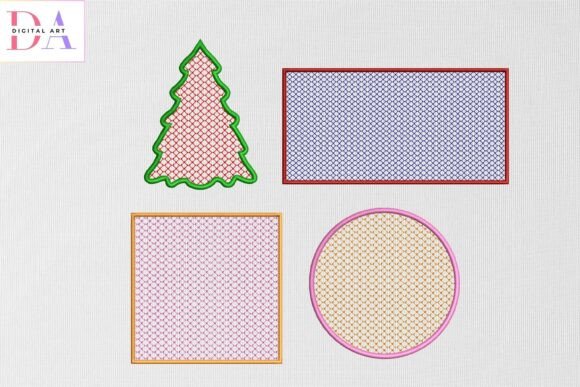
Geometric Frames and Tree thrives where structure meets personality—especially on items that carry visual weight and purpose. On a heavyweight canvas tote bag? Perfect. The rectangle and square frames anchor the composition, while the tree adds joyful contrast without overwhelming. As apron embroidery? Ideal for the upper chest or pocket—its symmetry reads clearly from across a crowded market aisle. For tea towel embroidery? It works best centered on the lower third, where the geometric lines echo kitchen cabinetry and the tree adds soft focal warmth. And as an embroidered patch? Absolutely standout—especially when fused onto denim jackets or market bags. Its four-design set gives boutique makers flexibility: mix the tree with the square frame on one pillow cover, then pair the rectangle and tree on matching pouches.
It also photographs exceptionally well for Etsy listings and printable mockups. Clean lines translate crisply in natural light, and the design’s inherent balance means it doesn’t need heavy editing to look premium. That’s critical for digital embroidery file sellers—the more trustworthy the preview, the higher the conversion on commercial embroidery listings.
What Holds It Back (And How to Fix It)
This isn’t a “stitch-and-go” design for beginners. The description hints at density—“festive tree, rectangle, square, and…”—and in practice, the tree motif likely carries tighter stitch clusters than the frames. That means stitch density matters. On textured towels or thick twill caps, those dense areas can pucker or lose definition without proper stabilizer choice and tension calibration. I recommend testing Geometric Frames and Tree on scrap fabric *before* cutting into your final run—especially for aprons and tea towels, where fabric texture varies wildly between batches.
Also, don’t assume it scales down gracefully. While the frames hold up beautifully at 3.5", the tree may blur or lose charm below 2.75". Avoid using it as a tiny accent on cuff patches or keychain tags unless you’ve verified clarity on your machine. And on dark fabric? Thread colors become non-negotiable—review your palette early. A pale mint tree on navy linen reads serene; the same thread on black cotton can vanish without metallic or high-contrast variegated options.
Booth Impact & Buyer Engagement
In person, Geometric Frames and Tree builds quiet confidence. It doesn’t scream—it invites. Customers pause, tilt their heads, and say, “Oh, I see the shape *and* the spirit.” That dual-read makes it a strong conversation starter at your craft fair table. Pair a framed tea towel with a matching embroidered pouch and a small pillow cover, and you’ve built a cohesive, giftable mini-collection—no extra signage needed. That cohesion strengthens brand consistency for small shop products and elevates perceived handmade quality. Buyers don’t just see stitching—they see curation.
For Etsy sellers and digital embroidery file shops, this set delivers smart design assets: four distinct but harmonized motifs mean customers can buy once and deploy across categories—patches, apparel, home goods—without licensing friction. Just confirm commercial licensing applies before selling finished products. (If it’s labeled for personal use only, rework is required.)
Production Notes Every Embroidery Designer Should Check
- Test first: Run Geometric Frames and Tree on scrap fabric matching your final product’s weight and weave—especially for curved cap surfaces or looped terry cloth towels.
- Contrast is king: Check thread colors against your base fabric under both daylight and booth lighting. What pops on screen may mute in person.
- Spacing & alignment: The geometric frames rely on precision. Verify spacing between elements holds true across hoop sizes—don’t assume auto-resizing preserves integrity.
- Hoop size matters: If the largest design pushes 5" wide, confirm your standard hoop fits—and whether your machine handles that comfortably in batch production.
- Stabilizer strategy: Use cutaway for knits and lightweight linens; tear-away for stable wovens like cotton duck or quilting cotton. Skip fusible-only for dense areas.
- Create one real mockup: Not digital—actual stitched, pressed, and displayed. See how light hits the stitches, how the frame interacts with garment seams, and whether the tree feels joyful or fussy in context.
- Compare fabric colors: A cream linen vs. oatmeal canvas vs. slate denim changes the entire mood. Let the fabric guide your thread choices—not the other way around.
Final Verdict for Handmade Entrepreneurs
Geometric Frames and Tree isn’t flashy—but it’s reliable. It’s the kind of embroidery file that sells steadily at craft fairs because it bridges trends (modern geometry) and tradition (holiday warmth), all while supporting scalable, repeatable production. It works for School-inspired collections, boutique kitchen lines, and thoughtful gifting—without leaning into seasonal cliché. For Etsy sellers building a library of versatile design assets, it’s a quiet powerhouse. For craft fair vendors curating tactile, photogenic displays, it’s booth-ready elegance. Just remember: its strength lies in intention—not speed. Respect the stitch density, honor the fabric, test early, and let the geometry do the talking. When done right, Geometric Frames and Tree doesn’t just decorate a product—it defines a moment of calm, color, and craft.